The carbonate ion is the classic example of resonance. One C=O double bond and two C–O single bonds look unequal on paper, yet all three bonds in the real ion are identical because the double bond is shared among the three oxygens.
CO32− Lewis structure, step by step
- Count valence electrons: C (4) + 3 × O (6) + 2 for the 2− charge = 24 electrons.
- Central atom: C. Carbon is the least electronegative atom other than hydrogen (2.55), so it goes in the middle.
- Bond each outer atom to C (3 bonds = 6 electrons), then complete the outer atoms (3 × 6 electrons as lone pairs). That uses 24 electrons.
- 24 − 24 = 0 electrons left for C, so it has no lone pairs.
- That leaves C with only 6 electrons, short of an octet. Move one lone pair from the outer atom into the bond: one C=O double bond. Now C has 8.
- Electron domains on C: 3 bonded + 0 lone = 3 (steric number). A double or triple bond still counts as one domain.
- AX3: trigonal planar electron geometry, trigonal planar molecular geometry, sp2 hybridization.
Shape, bond angle and hybridization
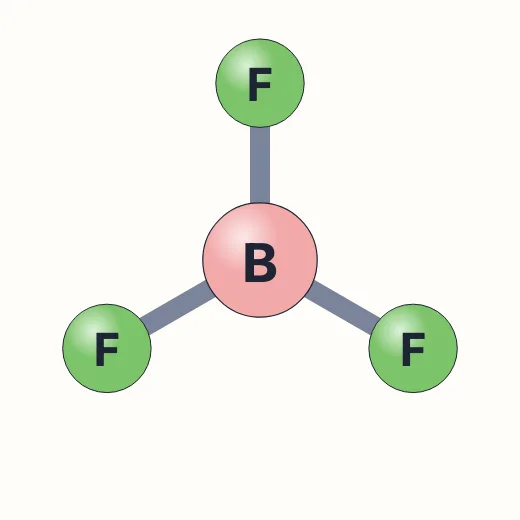
| Property | CO32− |
|---|---|
| Valence electrons | 24 |
| Central atom | C |
| AXE | AX3 |
| Electron geometry | trigonal planar |
| Molecular geometry | trigonal planar |
| Bond angle | 120° |
| Hybridization | sp2 |
| Polarity | Ion (net charge) |
Getting to 24 electrons
Carbon gives 4, the three oxygens give 18, and the 2− charge adds 2 more. Forgetting those two extra electrons is the quickest way to end up with the wrong structure.
Three resonance forms, one real ion
The C=O double bond can sit on any of the three oxygens, giving three equivalent structures. The real ion is a blend of them: every C–O bond has a bond order of 1⅓, and all three measured bond lengths are the same.
Where the charge sits
In any single resonance form, carbon and the double-bonded oxygen have formal charge 0 and each single-bonded oxygen carries −1. Averaged over the three forms, every oxygen holds −2/3, which is why the ion is perfectly symmetric.
Twin of the nitrate ion
CO32− and NO3− are isoelectronic: both have 24 valence electrons, three domains on the central atom, no lone pair, three resonance forms and a flat 120° triangle. Only the central atom and the charge differ.
Common mistakes
Watch out
- Drawing two C=O double bonds to give carbon more bonds; that puts 10 electrons on carbon, which a second-period atom cannot hold, so keep one double bond and two single bonds.
- Leaving off the brackets and the 2− charge; an ion's finished Lewis structure is always bracketed with its charge.
Practice questions
Try each one before opening the answer.
What is the C–O bond order in the carbonate ion?
4/3, about 1.33. Four bonds' worth of electron pairs (one double plus two single) are shared evenly over three C–O positions.
Is the carbon in CO32− sp2 or sp3?
sp2. The double bond counts as one domain, so carbon has three domains and no lone pair; its leftover p orbital forms the delocalized π bond.
Give the formal charges in one resonance structure of CO32−.
C is 0, the double-bonded O is 0 and each single-bonded O is −1. They add up to the ion's 2− charge.
CO32− compared with similar molecules
| Molecule | Valence e⁻ | AXE | Shape | Bond angle | Polarity |
|---|---|---|---|---|---|
| CO32− | 24 e⁻ | AX3 | trigonal planar | 120° | ion (net charge) |
| NO3− | 24 e⁻ | AX3 | trigonal planar | 120° | ion (net charge) |
| BF3 | 24 e⁻ | AX3 | trigonal planar | 120° | nonpolar |
| SO3 | 24 e⁻ | AX3 | trigonal planar | 120° | nonpolar |
Where you meet it
Carbonate is all over geology and the lab: limestone, chalk and marble are calcium carbonate, and they fizz in acid as the carbonate releases CO2.
Structure data: OpenStax Chemistry 2e, §7.6 Molecular Structure and Polarity. Shape rules: OpenStax Chemistry 2e §7.6.