Sulfur trioxide is the step between sulfur dioxide and sulfuric acid in industry. It is a flat triangle, and like SO2 it can be drawn two ways depending on how strictly you apply the octet rule.
SO3 Lewis structure, step by step
- Count valence electrons: S (6) + 3 × O (6) = 24 electrons.
- Central atom: S. Sulfur is the least electronegative atom other than hydrogen (2.58), so it goes in the middle.
- Bond each outer atom to S (3 bonds = 6 electrons), then complete the outer atoms (3 × 6 electrons as lone pairs). That uses 24 electrons.
- 24 − 24 = 0 electrons left for S, so it has no lone pairs.
- That leaves S with only 6 electrons, short of an octet. Move one lone pair from the outer atom into the bond: one S=O double bond. Now S has 8.
- Electron domains on S: 3 bonded + 0 lone = 3 (steric number). A double or triple bond still counts as one domain.
- AX3: trigonal planar electron geometry, trigonal planar molecular geometry, sp2 hybridization.
Both drawings are in use. Most general chemistry courses accept the octet form; courses that grade by formal charge expect the second one. Either way the VSEPR count is the same, because a double bond is still one domain.
Shape, bond angle and hybridization
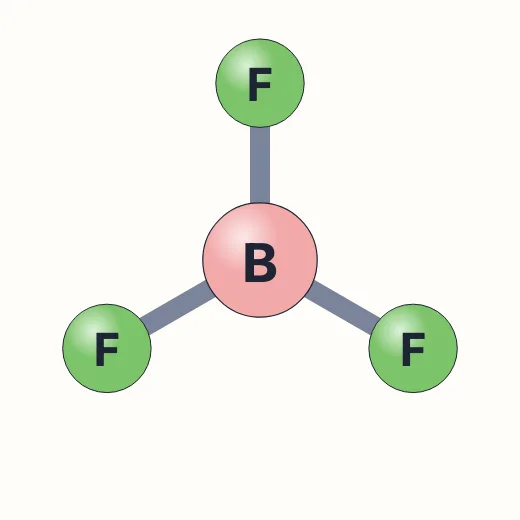
| Property | SO3 |
|---|---|
| Valence electrons | 24 |
| Central atom | S |
| AXE | AX3 |
| Electron geometry | trigonal planar |
| Molecular geometry | trigonal planar |
| Bond angle | 120° |
| Hybridization | sp2 |
| Polarity | Nonpolar |
Octet form: three resonance structures
Keeping sulfur at 8 electrons means one S=O double bond and two S–O single bonds. The double bond can sit on any of the three oxygens, giving three resonance forms, with +2 on sulfur and −1 on each single-bonded oxygen.
Formal-charge form: three double bonds
If sulfur may hold more than 8 electrons, three S=O double bonds bring every formal charge to zero, with 12 electrons around sulfur. Some textbooks present this as the best structure and others stick with the octet resonance set, so follow your course. Both predict the same flat shape.
No lone pair, so it stays flat
Unlike SO2, all six of sulfur's valence electrons go into bonding, leaving no lone pair. Three equal domains spread to 120° in one plane.
Polar bonds that cancel
Each S–O bond is polar, with an electronegativity difference of 0.86. In a symmetric triangle the three bond dipoles point outward 120° apart and sum to zero, so SO3 is nonpolar even though SO2 is polar.
Common mistakes
Watch out
- Giving sulfur a lone pair as in SO2: with 24 electrons, every one is used by the three bonds and the oxygen lone pairs, so the shape is trigonal planar, not pyramidal.
Practice questions
Try each one before opening the answer.
What is the formal charge on sulfur in the octet-rule structure of SO3?
+2. Sulfur has 6 valence electrons, no lone-pair electrons and 4 bonds (one double, two single): 6 − 0 − 4 = +2.
Why is SO3 nonpolar while SO2 is polar?
SO3 has no lone pair, so its three bonds are arranged symmetrically and the dipoles cancel. SO2 has a lone pair that bends it, leaving a net dipole.
What is the hybridization of sulfur in SO3, and what is the O–S–O angle?
sp2, with 120° angles, because sulfur has three electron domains and no lone pairs.
SO3 compared with similar molecules
| Molecule | Valence e⁻ | AXE | Shape | Bond angle | Polarity |
|---|---|---|---|---|---|
| SO3 | 24 e⁻ | AX3 | trigonal planar | 120° | nonpolar |
| SO2 | 18 e⁻ | AX2E | bent | ≈ 119° | polar |
| BF3 | 24 e⁻ | AX3 | trigonal planar | 120° | nonpolar |
| CO32− | 24 e⁻ | AX3 | trigonal planar | 120° | ion (net charge) |
Where you meet it
SO3 is made in the contact process by oxidizing SO2 over a vanadium(V) oxide catalyst, then turned into sulfuric acid; it also forms in polluted air on the way to acid rain.
Structure data: OpenStax Chemistry 2e, §7.6 Molecular Structure and Polarity. Shape rules: OpenStax Chemistry 2e §7.6.