The nitrate ion is found in fertilizers, nitric acid and many lab salts. It is the classic polyatomic ion for practising charged Lewis structures and resonance at the same time.
NO3− Lewis structure, step by step
- Count valence electrons: N (5) + 3 × O (6) + 1 for the 1− charge = 24 electrons.
- Central atom: N. Nitrogen is the least electronegative atom other than hydrogen (3.04), so it goes in the middle.
- Bond each outer atom to N (3 bonds = 6 electrons), then complete the outer atoms (3 × 6 electrons as lone pairs). That uses 24 electrons.
- 24 − 24 = 0 electrons left for N, so it has no lone pairs.
- That leaves N with only 6 electrons, short of an octet. Move one lone pair from the outer atom into the bond: one N=O double bond. Now N has 8.
- Electron domains on N: 3 bonded + 0 lone = 3 (steric number). A double or triple bond still counts as one domain.
- AX3: trigonal planar electron geometry, trigonal planar molecular geometry, sp2 hybridization.
Shape, bond angle and hybridization
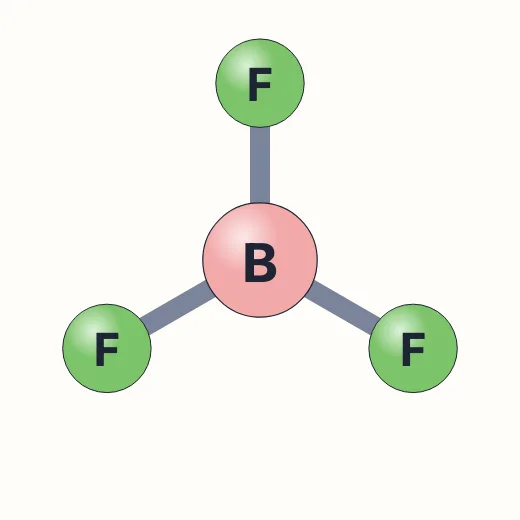
| Property | NO3− |
|---|---|
| Valence electrons | 24 |
| Central atom | N |
| AXE | AX3 |
| Electron geometry | trigonal planar |
| Molecular geometry | trigonal planar |
| Bond angle | 120° |
| Hybridization | sp2 |
| Polarity | Ion (net charge) |
Counting the charge
Nitrogen gives 5 and the three oxygens give 18, which makes 23. The 1− charge adds one more electron, for 24. Forgetting that extra electron is the most common way to get this structure wrong.
Three equivalent resonance forms
Nitrogen keeps its octet with one N=O double bond and two N–O single bonds. The double bond can go to any of the three oxygens, so there are three resonance forms, and every N–O bond in the real ion has a bond order of 4/3.
Where the charges sit
In each form, nitrogen carries +1 and each single-bonded oxygen carries −1, adding up to the overall 1−. Averaged over the three forms, the negative charge is shared evenly by all three oxygens.
Why nitrogen can't take three double bonds
Unlike sulfur in SO3, nitrogen is in period 2 and is not drawn with more than 8 electrons. So nitrate has no all-zero formal-charge version, and the octet resonance set is the structure textbooks expect.
Common mistakes
Watch out
- Using 23 electrons instead of 24: add one electron for each negative charge before placing any bonds.
- Leaving off the brackets and charge: write the finished structure inside square brackets with 1− outside to show it is an ion.
Practice questions
Try each one before opening the answer.
What is the N–O bond order in NO3−?
4/3, about 1.33. Four bonding pairs are spread over three equivalent N–O bonds across the resonance forms.
What is the formal charge on nitrogen in the nitrate ion?
+1. Nitrogen has 5 valence electrons, no lone pairs and 4 bonds (one double, two single): 5 − 0 − 4 = +1.
Compare the shapes of NO3− and NH3.
NO3− has no lone pair on nitrogen, so it is trigonal planar at 120°. NH3 has a lone pair on nitrogen, so it is trigonal pyramidal at about 106.7°.
NO3− compared with similar molecules
| Molecule | Valence e⁻ | AXE | Shape | Bond angle | Polarity |
|---|---|---|---|---|---|
| NO3− | 24 e⁻ | AX3 | trigonal planar | 120° | ion (net charge) |
| CO32− | 24 e⁻ | AX3 | trigonal planar | 120° | ion (net charge) |
| SO3 | 24 e⁻ | AX3 | trigonal planar | 120° | nonpolar |
| BF3 | 24 e⁻ | AX3 | trigonal planar | 120° | nonpolar |
Where you meet it
Nitrate is in fertilizers, in the nitric acid and nitrate salts used in school labs, and in the nitrogen cycle, where soil bacteria turn it back into N2.
Structure data: OpenStax Chemistry 2e, §7.6 Molecular Structure and Polarity. Shape rules: OpenStax Chemistry 2e §7.6.